
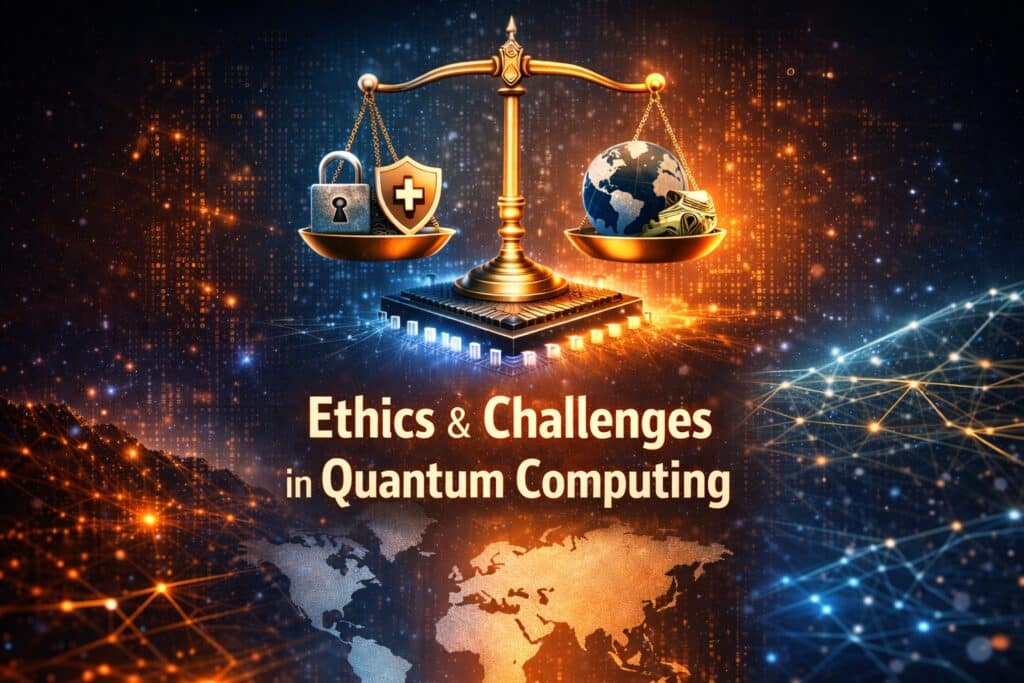
Ethical Challenges in the Quantum Computing Era
Quantum computing promises to transform fields ranging from cryptography to drug discovery. However, with great computational power comes an equally significant responsibility: ensuring that quantum technologies are developed and deployed ethically and responsibly. So we can explore the ethical challenges in the quantum computing era.
The Cryptography Disruption
One of the most widely discussed ethical implications of quantum computing concerns cryptography.
Many of today’s encryption systems rely on the computational difficulty of problems such as integer factorization and discrete logarithms. Large-scale quantum computers could potentially break widely used encryption schemes through algorithms like Shor’s algorithm.
This raises serious concerns:
- Exposure of sensitive historical data
- Compromised financial systems
- Risks to national security
- Threats to personal privacy
To address this challenge, the global cybersecurity community is working on post-quantum cryptography, encryption methods designed to resist quantum attacks.
Unequal Access to Quantum Power
Another ethical concern is technological inequality.
Quantum computers are extremely complex and expensive systems. In the early stages of their development, access may be limited to:
- Governments
- Large technology companies
- Major research institutions
This could create a significant power imbalance in areas like finance, defense, and artificial intelligence.
Ensuring fair access and avoiding technological monopolies will be an important challenge for policymakers and international organizations.
Responsible Innovation
Responsible innovation in quantum technologies requires collaboration between:
- scientists
- engineers
- policymakers
- ethicists
- industry leaders
Important questions include:
- How should quantum capabilities be regulated?
- Who should control critical quantum infrastructure?
- How can society prepare for quantum-enabled cyber risks?
Building Ethical Frameworks Early
Unlike previous technological revolutions, we have a unique opportunity with quantum computing: we can address ethical issues before the technology reaches full maturity.
By integrating ethics, governance, and transparency into quantum research today, we can help ensure that the benefits of quantum computing are distributed broadly and responsibly.